All posts by Esteban D. Dortta

About Esteban D. Dortta

Esteban is an evangelical pastor. He studied theology at the Baptist Theological Seminary of Uruguay between 1991 and 1994. Born in 1971, he lives in Brazil since 1995. Understands that freedom of thought, expression and reunion are essential to the development not only of Christian but of the whole society.

I, Samson

Judges 13:1-16:31

This is not a triumphalist article.

It is deeply human, existential, harsh, heavy… realistic.

If you enjoy happy endings, today, this is not your place.

We all know the story of Samson. It is as necessary as that of Joseph in Egypt.

But let’s forget all the introductory material.

Let’s focus on his last day of life. Let our imagination soar a bit. Without feeling the passage, it’s just information.

After

The last memory he had was well imprinted.

Not that he had any retinas left on which to imprint anything. He, one of the greatest judges of Israel, had been brutally blinded by his enemies.

He could still hear the shouts of joy from the Philistines when it happened. He remembered how, helpless, he was dragged by four not very strong men. His forehead was tied to the trunk. And the executioner brutally gouged out his eyes with a red-hot iron.

And then came the silence.

Not because the evening crowd wasn’t braying victoriously after years of being defeated by Samson. But because the pain he felt was so intense that no other sense could function properly.

The years of victories passed through his mind. The battles won. Being a person of courage and respect among his people. The feeling of his Creator’s presence in his body in a way completely different from any other human. The care his parents gave him. The affections he was exposed to. The expectations since before the womb.

All was lost.

Nothing made sense anymore.

He thought: What am I grinding? Wheat for the great? Barley for the poor? And what difference would it make?

They put him to do the work of a beast of burden: grinding, crushing, pulverizing.

From dawn to dusk, the ever-stronger Samson did only one thing: turn and turn. Push and push. Grind and grind.

He who once instilled fear and dread in any Philistine warrior was now a laughingstock for the children. They threw stones at him. Laughed at him. Spat in his face.

The important thing was that the Philistine people, from the tenderest to the hardest, knew that the great judge of Israel had been defeated.

What did it matter if it was barley for the poor or wheat for the rich!?

The situation would repeat itself in the same way.

Day after day. Week after week. Memory after memory.

The stone turned.

The dust rose.

The body obeyed.

Push. Breathe. Turn.

Push. Breathe. Turn.

And as the stone returned to the same place, Samson also returned.

Returned to the woman of Timnah, to that first Philistine woman his eyes chose before his spirit could say no. Returned to the riddle, the feast, the wrath, the foxes setting the fields ablaze. Returned to the gates of Gaza carried on his shoulders as if no one could stop him.

Returned to the dead lion’s body and the honey taken from within it. To what he touched, though he should not have touched. To what he ate, though his consecration demanded separation.

Returned to vengeance. Always to vengeance.

One blow demanded another. One humiliation demanded a response. One fallen enemy was never enough.

And he returned to her…

Returned to Delilah. To her insistence. To his vanity. To his certainty that he could play with danger once more. And again. And again.

Until one day, there was no strength left to play.

The worst part was that he knew…

And what he knew was heavier than the stone he turned day after day. For he did not carry it on the outside, but on the inside.

It wasn’t Delilah.

It wasn’t the Philistines.

It wasn’t his parents.

It wasn’t his first wife.

It wasn’t his people.

They had participated. They had hurt, deceived, pressured, betrayed. But none of them had put Samson in that prison.

He knew where it all began.

Not the day Delilah cut his hair.

Not the day the Philistines captured him.

Not the day they gouged out his eyes.

It began long before — each time he confused strength with invulnerability; each time he confused desire with right; each time he used God’s calling as if it were his own possession.

Samson had not fallen all at once.

He had descended step by step, calling each step a choice.

Now, blind, he turned the stone.

And the stone did not argue with him.

Did not seduce him.

Did not betray him.

Did not flee.

It just returned to the same place.

There comes a moment when life ceases to be what we can still do and begins to be also what we can no longer undo.

Samson must have known that moment when he opened his eyes and saw nothing.

There was no more youth, strength, freedom. There was no way to go back to Timnah, erase Gaza, take back spoken words, undo choices, put eyes back in their sockets. There was only the sound of chains and the mill turning. One turn. Another turn. Another.

I have thought that some forms of repentance begin exactly there: when we finally understand that God can forgive us without restoring the life we’ve squandered.

What Did I Do with What I Received?

It is possible to blame Delilah for many things. But Delilah arrived late in the story.

Before her, there was already a man accustomed to desiring and taking, advancing and then dealing with the consequences. A man set apart from the womb, visited by the Spirit, extraordinarily gifted — and incapable of governing himself.

That is the part that frightens me.

Because I have received much.

And I know no other honest way to say this: I have squandered much.

There comes a moment when explaining childhood, wounds, the people who betrayed us and those who abandoned us begins to seem like a desperate attempt to find someone to share with us a guilt that is ours.

David could weep, but the child died. Moses could view the land, but did not enter it. Peter went out into the night and wept bitterly. There are things that God’s forgiveness heals before eternity without erasing from history.

The Mill

Perhaps that is why I am so troubled by a certain Christianity incapable of standing before ruin.

Everything must end well. God will restore. God will return. You will receive seven times more.

Perhaps.

But Samson did not get his eyes back.

There are losses that are not attacks of the Devil. They are consequences. There are doors that God may not reopen. There are years that no prayer will recover. And to call this a lack of faith would be merely to add falsehood to sin.

The mill keeps turning.

And perhaps one of the loneliest experiences of existence is realizing that the one pushing that stone is ourselves.

“Remember Me”

Then there remains a prayer.

Not: “Give me everything back.”

Not: “Make it like it was before.”

Samson already knew there was no more “before.”

So there remains a small phrase. Brief. Harsh. Direct:

“Sovereign Lord, remember me.” (Judges 16:28)

Perhaps this is the possible prayer when we have no more arguments.

I have sinned.

I have squandered.

I have hurt.

I have not been faithful to what I received.

And now?

I don’t know.

That may be the truest answer I can offer.

I don’t know what God will still do with the remnants of my story. I don’t know what will be returned and what will remain lost. I don’t know if there is again a pulpit, a home, a hug, a child, a friend, or just some columns before me.

I only know that yesterday no longer exists.

Tomorrow has not yet been given to me.

And, by some mercy I cannot explain, today still exists.

I Believe, but I Don’t Belong to a Congregation

When Not Belonging Seems to Make Sense

Throughout my life, I’ve met various individuals and couples who chose not to belong to a congregation. They had faith in Jesus, but for various reasons, they were not part of a congregation. Some even maintained a devotional life, professed their faith in Jesus to others, but were not part of a congregation. Occasionally, they would visit a local or distant church, but they did not maintain fellowship with any congregation.

The reasons are varied. And many of them are quite understandable.

There were those who had been deeply and unjustly hurt by a pastor, a deacon, or a group of people from the congregation they belonged to. This reminds me of Psalm 55:12-14, which we can summarize as saying those who live with me are not trustworthy. Other texts in this sense might be Ezekiel 34:1-6 and John 10:11-13.

For others, the liturgy stopped making sense. It no longer communicated anything significant to their lives.

I also remember cases where they felt they no longer fit in anywhere. They would go here and there and always feel like a fish out of water.

I recall others who simply became exhausted from so much internal conflict and weariness.

And I know of cases where they succumbed to the arguments of friends, family, ideas from outside where being a Christian was a reason for mockery and ridicule.

We could also mention other cases like periods of transition, illness, changes, and other circumstances that can distance someone from the community.

I think, then, that it is perfectly understandable for someone not to be part of a congregation for a while for various reasons.

The problem begins when a circumstance turns into a conviction: “I believe in Christ, but I don’t need to belong to His people.”

Sometimes You Need to Leave That Church

Not every departure from the institutional church means a departure from Christ. There are pastors who wound, sick communities, and environments where staying may mean continuing to be subjected to manipulation or emotional and/or spiritual violence.

Ezekiel 34 resonates with me in this regard.

If this were a sermon, there would be several divisions: 1-6; 7-10; 11-16; 17-19; 20-24 and 25-31.

For the purposes of this article, we will only consider two parts: 1-10 and 17-31.

In the second part (Ezekiel 34:17-31), it speaks of the responsibility of the sheep themselves, and the prophet says that God Himself will “judge between one sheep and another” and “I will judge between the fat sheep and the lean sheep.” In other words, part of the congregation is responsible for the weakness of another part.

However, I am interested in the first part (Ezekiel 34:1-10). The shepherds were tending to themselves while the sheep were scattered. And worse, this dispersion distanced them not only from the congregation but from the Creator Himself.

Ezekiel 34:6 says, “”My sheep wandered over all the mountains and on every high hill.”” To the casual reader, this means they went looking for other pastures or other places. And—while this is true—when we see mentions of high places in the Bible, it is an indirect reference to places of worship distinct from the places of worship to God.

See Numbers 33:51-52, where God commands the destruction of Canaanite religious implements “among them the high places.”

Or the wisest king recorded in the Bible who succumbed to earthly desires. 2 Kings 11:7 tells us that Solomon built “high places” for Chemosh and Molech, foreign gods.

Personally, I know people who—for perfectly understandable reasons—left the congregation but later associated with beliefs contrary to the Christian faith grounded in the Bible. This is what the “high places” are talking about.

But what makes the text vehement in its line of argument is that the reason for all this is that the shepherds care only for themselves. Verses 4-5: “You eat the curds, clothe yourselves with the wool and slaughter the choice animals, but you do not care for the flock. You have not strengthened the weak or healed the sick or bound up the injured. You have not brought back the strays or searched for the lost. You have ruled them harshly and brutally.

This is pastoral violence. Abuse. Violence. Manipulation.

So, leaving a congregation may be necessary; concluding that we no longer need a community is another matter.

The wound explains the isolation. The new conviction explains the self-protection.

If you are a pastor who scatters sheep, return to your original calling (if it is real). Take a look at Acts 20:28-30.

Isolation Can Cease to Be Protection and Turn into Autonomy

Being alone brings certain immediate emotional advantages. One of them is that no one contradicts me. There is a certain tranquility in realizing that there is no one else looking at me, meddling in my life, asking personal questions, correcting some attitudes and beliefs.

I can also—with all modern resources—create my own menu of preachers I like since they say what I like. (2 Timothy 4:4) I can choose the spiritual diet to follow and even have my own definition of which sins I consider important.

I then set up a personal “church” on the internet where all the “pastors” say exactly what I like to hear.

I have achieved peace. I have reached Nirvana. My soul has nothing more to worry about.

But the New Testament presents a faith in which I not only know others (as on the internet) but am also known. In this faith, we serve and are served; we correct and are corrected; we bear with and are borne with.

In these times, such a place is very uncomfortable. And you don’t have to physically leave the congregation to not be—in fact—in fellowship. It is quite possible to enter and leave all the services throughout the year and not know or be known by anyone. Society—increasingly individualistic—teaches and encourages us to isolate ourselves more and more and calls it “full life,” “empowerment,” etc.

On the other hand, it is wrong to think that all this is only due to modernity.

The epistle to the Hebrews, written during the second generation of Christians, still largely linked to the Jewish religion, which was a legal religion for the Roman Empire, raises a particularly uncomfortable point: there are people who watch over us and before whom there is some form of submission (Hebrews 13:7, 17).

Evidently, this does not grant absolute authority to any pastor. The freedom of conscience, belief, and practice continues to exist because we are fully responsible for our actions. Even for those that are a reaction to an explicit violation of our person.

But it also does not allow for a completely autonomous faith. And that is the point that hurts so much for those who—justifiably—decided not to belong anymore.

Following Christ Means Identifying with His People

The letter to the Hebrews is particularly interesting in this context.

The first to believe in Jesus as the Messiah (Christ) were Jews. They did not see themselves as a separate project from the Jewish people but as a continuation. That is, participating in the chosen people by believing in a Messiah who had been promised since ancient times fit very well with the Messiah now revealed and proven resurrected by many witnesses.

On the other hand, the Jewish religion—as we mentioned earlier—was a legal religion within the Roman Empire. And there were some special characteristics worth highlighting: it was the only monotheistic religion, and there was a form of covenant between the Romans and the Jews in which the former tolerated their religion, provided they made prayers for the emperor. All this in a region (the eastern part of the empire) where there were already provinces that had requested permission (29 BC) to build temples linked to the cult of the ruler. This practice would consolidate throughout the empire by the end of the first century.

The epistle to the Hebrews is written at least by the end of the first century. The author himself declares that both he and the readers are not eyewitnesses of the ministry, death, and resurrection of Jesus. (Hebrews 2:1 “We must pay the most careful attention, therefore, to what we have heard”. Hebrews 4:2 “For we also have had the good news proclaimed to us…”) That is, they are at least the second generation of believers in Jesus as Christ (Messiah).

These Jewish believers in Jesus did not want to separate from Jewish fellowship. And this, in the time they lived, made a lot of sense. Enrolled in the Jewish religion and being tolerated by the Jews themselves, they became untouchable by the Roman Empire.

But if they identified as followers of Jesus as a divine being, and therefore outside the Jewish religion, they could be classified as rebels, pagans, and subject to all sorts of punishments, potentially leading to death. That is why the author says in Hebrews 12:4-5, “In your struggle against sin, you have not yet resisted to the point of shedding your blood. And have you completely forgotten this word of encouragement…

If we trace a timeline, the first persecutions of Christians date back to 70 AD, when—after the war between Jews and Romans—tensions between Jews and Christians increased, and this often also affected Christian communities. After that, the Christian movement began to be perceived more frequently as separate from Judaism, which affected how local authorities treated the groups.

And things worsened with Domitian (81-96). It is common to find references to repressions under his rule. There is ancient tradition, such as that of Eusebius, associating the period with suffering and exile of Christians.

It is around this time that the epistle to the Hebrews was written. Things were getting tense for Christians. And these Jews who had believed were abandoning the congregation (Hebrews 10:24-25), and they did so seeking to avoid death (Hebrews 12:4-5), which is a perfectly understandable reason.

Every Christian (Jewish or not) knew that things were getting worse. By the time of Trajan (98-117), there were already judicial persecutions and well-established procedural policies. There was not yet widespread mass killing, but we can affirm that by the beginning of the second century, there was real repression by imperial decision implemented in the provinces.

So, the recipients of the letter clearly knew the cost of being publicly associated with the faith and the Christian community. Some Christians had suffered, lost possessions, and been publicly exposed. What we would today call cancel culture but in a cruder version.

In this context, the “not giving up meeting together” of Hebrews 10:25 means much more than regularly attending worship. It is public community identification.

Some might see here a call to collective martyrdom. But nothing could be further from the truth. As Christians, we love life. But the truth that the gospel reveals is much greater than any social religious scheme. And precisely for this reason, it cannot enter into relations of compromise or convenience with any other type of spiritual manifestation.

A careful and contemporary parallel can be drawn.

Today it is socially comfortable to say: “I have my spirituality.” Advancing a little further, someone might say, “I follow Jesus” or even “I follow Jesus with my own convictions.”

More difficult is to say: “These Christians are my people. Yes, I belong to a concrete and imperfect community.” That indeed requires courage and full conviction beyond the status quo.

Christ does not call only individuals. He incorporates people into a body. His body, of which He is the head. (See Hebrews 2:12 and 12:23; Ephesians 1:22-23; Colossians 1:18; 1 Corinthians 12:12-27)

Congregation Is Not Attendance; It’s Shared Life

The solution to “I believe, but I don’t belong” is not “then go to church on Sundays.”

There is a tremendous superficiality and lack of fellowship in merely attending worship. Someone can do this without missing a single Sunday for forty years and still not be part of the congregation. Continuing practically alone. The only variant of the expression “I believe, but I don’t belong” is that the person believes but—in fact—is not part of the congregation.

My maternal grandmother lived in the capital, and with my mother, we would occasionally visit her. On the perpendicular street half a block away, there was a karate school. I must have been about 9 to 11 years old. I loved going and watching them practice this martial art. The shouts. The synchronized movements. The kimono. The tatami. The environment. The smell. Everything was etched in my memory. Years later, when I was 17, I taught programming classes in a neighboring city to ours. We had a twenty-minute break between one class and the next. I would run to see one of two things: karate training or a game of bocce.

Needless to say, I didn’t learn karate or how to play bocce.

No one becomes physically healthy by entering the gym once a week, wearing the appropriate exercise clothes, bringing a liter of water, and sitting for an hour watching other people exercise and then going home. Health requires a life in which certain practices become habitual. And that is difficult.

The Christian community works similarly, only much deeper.

But first, let me present some ideas about the word communion. This word of Latin origin (communio) derives from com (meaning “together”) and munis (meaning “charge” or “obligation”) and is used in the sense of “common participation,” “having something in common.” An easy way to remember the meaning would be “common union” or “common charge.”

Those of us who believe in Jesus as God incarnate and Messiah (Christ) share many things. Obviously, due to the nature of this faith, it excludes any other type of similar, resembling, or analogous faith. Christians share the exclusive faith in Jesus as the only and sufficient savior. Christians (regardless of institutional label or Christian tradition) are part of the same body and have one mediator (1 Timothy 2:5; Ephesians 4:4-6; 1 Corinthians 12:12-27).

There is no possible way to practice communion alone. It only serves to avoid the hardships of the disapproving looks of non-believers.

We pray together. We bear burdens. We share. We confess. We teach. We are corrected. We learn. We forgive. We celebrate. We weep. We serve. We are known.

These are things that society has always taught are not appropriate for the individual.

Salvation, therefore, is not just an individual thing, as much as it begins there. It is—above all—communal.

It is significant that much of the New Testament’s instructions contain the expression “one another.” There is no way to practice them alone.

(Acts 2:42-47; Galatians 6:2; James 5:16)

Perhaps the Question Is Wrong

When we ask if a Christian needs to go to church, we may have reduced the issue too much. As if we had placed a magnifying glass over only one part of the subject.

There may be times when we cannot belong. There may be churches from which we need to leave. There may be wounds that take time to heal. And none of these situations should be treated superficially or with indifference.

However, there is another question: “Is it possible to follow for a long time the one who made us part of a body while deliberately refusing to live as part of that body?

The Christian life described in the New Testament does not seem to know a permanently solitary faith.

Not because God is taking attendance on Sundays, but because there are entire dimensions of the Christian life that simply do not exist when we are alone.

I cannot bear the burden “of one another” alone.

I cannot forgive “one another” alone.

I cannot confess “to one another” alone.

Nor can I easily discover where I am wrong if all the voices I hear were chosen by me.

Perhaps belonging is not simply an obligation of the Christian life.

Perhaps it is one of the ways Christ keeps alive and healthy the faith we claim to have in Him.

Fear of Believing

Believing is allowing the word of Christ to hold more authority over us than what we’ve learned to consider true, safe, and possible.

Túlio was an exemplary bank employee. For the last 20 years, he moved from branch to branch until he settled in that city. He started a family, had children, and he and his wife raised them closely and diligently. Raised in a Christian family with an evangelical tradition, he attended the local church with his family. Sundays, Tuesdays, and Saturdays, they were present. He contributed financially and was an active deacon. Internally, he was a balanced man. Debt-free. Of good reputation. He just had a terrible fear of believing. But he wasn’t even aware of it.

The problem isn’t simply believing.

We can believe in Jesus without allowing Him to deeply alter what we believed before Him. We come to faith carrying an interpretation of the world shaped by family, culture, religion, and political experience. The problem begins when Jesus contradicts some of these certainties. At that moment, we discover if we truly believe in Him or if we merely accommodate Him within what we already believe.

Peter on the Water – When Experience Says It Can’t Be.

The passage from Matthew 14:22-33 is well-known. In short: the disciples are in a small boat in the middle of the sea under strong winds. Jesus approaches. The disciples see Him walking on the water. Peter asks to prove that it is Him walking on the water. Jesus invites him. Peter goes. Walks. Gets scared. Begins to sink. Jesus reaches out His hand and says, “You of little faith, why did you doubt?”

Peter is not just anyone. He is a middle-aged man whose profession was fishing. He knew the sea. He had ample reasons from his experience to stay in the boat. He knew clearly that it was not possible for a man to walk on water.

Perhaps precisely for this reason, he asks to walk to Jesus as proof that He was who He appeared to be—from a distance.

And perhaps for the same reason, Jesus performs no miracle, He simply says, “Come.”

One single word.

For a few moments, Peter allows this specific word from Jesus to carry more weight than his experience. Then he looks again at what he had long known: wind, water, danger. He was afraid. He began to sink.

Of course, like any text, it can hold an allegorical reflection. We could say that the water and wind are the problems and that the path over the sea is the path we are treading, that is, our life. And while this sounds very beautiful—and we will end up drawing a moral or spiritual lesson from it—the account is historical and should be treated as such.

The fact is, the wind didn’t start when Peter got scared. The wind, the water, the waves, the boat, Jesus in the distance, the other disciples in the boat. Everything was there before. It was like this when he jumped over the side of the little boat and began to walk on the water toward Jesus.

So what changed? Prior knowledge entered his mind, and he was afraid.

Fear has this peculiarity of wanting to protect us from something. They say it’s better to be a live coward than a dead hero. (The Bible says, “a live dog is better off than a dead lion” – Ecclesiastes 9:4)

Was the prior knowledge to the walk wrong? No. In fact, these data had greatly helped him in the task at sea, which demands great respect. So his belief in these previous experiences (personal or not) was not wrong.

Thus, there are moments when believing means admitting that our experience is true but does not have the final word.

Nicodemus – When Religion Has No Category for What God Is Doing

Another well-known and interesting text for our point today is John 3:1-15

“We know that you are a teacher who has come from God.” This was Nicodemus’s introductory phrase that night.

Nicodemus is not an ignorant unbeliever. It is precisely his religious knowledge that makes the conversation interesting. Two Jewish teachers sitting on a cool night discussing their beliefs. A dialogue of equals in a certain sense. And his knowledge was not wrong. Jesus does not dismiss it. But He sees a shadow in all this. Something wanting to appear behind Nicodemus’s words that did not crystallize in his first statement.

Jesus (in His “Tramontina Quick Cut” version) does not miss the opportunity and proposes an existential dilemma that cannot be answered by Nicodemus’s religion: “No one can see the kingdom of God unless they are born again.”

Jesus speaks of being born again, and Nicodemus tries to fit it into the categories he already possesses: “How can someone be born when they are old?”

Nicodemus’s question is much more than obvious. It was then and is now. And the answer—within the physical realm—remains obvious.

However, from the source of evils that afflict us, the body is the most virtuous. Existential afflictions rooted in the soul need another type of answer.

So, pause and analyze: Isn’t Nicodemus’s dilemma that night similar to ours? He was trying to understand God’s novelty using only the religious categories he brought with him. The baggage.

Thus, sometimes our difficulty in believing does not come from a lack of religion, but from the difficulty of admitting that God is greater than our religious understanding of Him.

Peter and the Unclean Animals – When God Contradicts What We Learned as Faithfulness

This other text is also well-known. Perhaps not as much as the others, but I think it fits into those texts that deserve a second look (and which doesn’t?) Acts 10:9-20

Unlike the Peter of Matthew 14, here we find a different Peter. Particularly strong in faith. He is already an apostle, has already confessed Christ. He has already received the Holy Spirit. He has already boldly preached Jesus. He has already been imprisoned. He has already said that famous phrase “We must obey God rather than human beings.”

However, there was a small part of his inner self that still needed to be enlightened. He needed to have some beliefs dismantled.

An idea that troubled me for years is the full and instant transformation of a person when they convert. All my biblical knowledge led me to conclude that the transformation at the moment of conversion is deep, radical, and lasting. This inevitably raised other doubts in my heart: When did I convert? Am I truly converted? My beliefs needed to be dismantled.

So, when Peter hears “Get up, Peter. Kill and eat,” the most direct, correct, simple, and natural response that arises from his head is allied to biblical knowledge and the practice of a lifetime: “I have never eaten anything impure or unclean.”

Just as it happened with the betrayal and his restoration, Peter needed three redundant visions (like the three denials or the three questions about love) and a clear and strong voice that put an end to an era in his life (like the rooster and like Jesus on the beach), said—in the last two times—affirmed: “Do not call anything impure that God has made clean.”

Peter, like Paul persecuting the church, was firm in his convictions. He was faithful. This is Hebrew faith in practice: faithfulness that makes the believer part of the body. (“the righteous person will live by his faithfulness” Habakkuk 2:4)

Note to those who already know the text: The Greek “pistis” cannot fully convey the concept of the Hebrew “emunāh” even though it comes very close. The Hebrew word conveys faith, faithfulness, or firmness/constancy. “Pistis” carries more faith in the sense of trust and can indeed carry something of faithfulness or adherence. However, it does not exhaust the Hebrew term, even being the best term in Greek to express the Hebrew without resorting to neologisms. The Greek term brings the idea of an act or attitude of believing, while the Hebrew drags the concept of firmness, reliable constancy. Thus, Romans 1:17—for Luther and the entire Protestant world and later Reformed and by extension fundamentalists and evangelicals—is read as “The righteous will live by faith ,” (note the comma. With this, I want to represent that in Paul we can understand that the person reaches righteousness from (“ἐκ”) faith) to the point that Habakkuk could be read “The righteous, by faith (faithfulness, constancy) will live” which brings profound consequences in the concepts of justification, redemption, salvation, etc. Then arises the problem of translations into Portuguese. What to do? Is it faithful to the original literal text or does it follow the interpretative line by understanding that Paul (of Hebrew faith converted to Jesus) writing in Greek follows the Septuagint? I am of the idea that it should remain faithful to the original text, and it is up to us—through exegesis and hermeneutics—to show clear evidence of this distinction instead of adopting the reformers’ interpretation as absolute truth. But all this deserves another article. Suffice it to say that salvation, justification, and redemption depend on faith and extend to faith. Outside of it (and exclusively it), nothing is done.

Returning to the subject of Peter and his vision.

As we were saying: Peter (like Paul) was being faithful to his biblical knowledge. The Law forbade him from eating unclean things, and he was faithful in this.

But things had changed. And the disciples (and many of us) did not fully understand what this was all about in the end.

So, some of the beliefs that God needs to correct in us are precisely those we learned to defend in His name.

Peter Rebuking Jesus – When Christ Threatens the Messiah We Want

Read the text of Matthew 16:13-23. I know it is known. But with everything you’ve read so far, there are some things that should jump out at you now, even if it’s not what I’m going to say next.

This text is very intimate, personal. It’s the small group of disciples and Jesus. They have just arrived at Caesarea Philippi. And the Jewish teacher, following the dialectical tradition of the rabbis, begins with a question: “Who do people say the Son of Man is?” In other words, what do people think about me? Who am I in their idea?

It’s obvious that Jesus knew what people thought. He had shown this repeatedly through dialogues, speeches, and direct confrontation. His disciples knew that He knew. So the question pointed in another direction. A more intimate one perhaps.

And the answers came, spontaneously and noisily. “John the Baptist,” “Elijah,” “Jeremiah,” “or one of the prophets.”

They reached the end of the options they knew, and I imagine there was a silence. The one that precedes the real question. I can imagine Jesus looking at all of them as if ready to present His most sensitive point. Then He spoke.

But what about you? Who do you say I am?

I imagine more silence. In Jesus’s gaze, the sincerity of one who with the question seeks to teach something more. And Peter breaks the silence: “You are the Messiah, the Son of the living God.

And I, guess what, imagine more silence. In the minds of the other Jewish disciples, there were certainly thoughts like: “He’s gone mad.” “Yeah. The desert heat fried his brains. He got here with abundant vegetation and completely lost it.” “Man… he’s blaspheming.” “How can an individual be the son of YHWH?”

Jesus turns to him and says: “Blessed are you, Simon son of Jonah, for this was not revealed to you by flesh and blood, but by my Father in heaven.

For those who like to study more: natural theology—that which intends to sustain itself only from non-biblical revelation and is obtained through the senses—can reach the conclusion that, considering what nature reveals, there must be a creator god. Paul seems to point in this direction in Romans 1:19-23ff. But to understand Him as the unique and personal creator, special revelation is necessary: the Bible. So, this general, universal knowledge, accessible to any individual, serves—by the conduct that this individual has afterward—only to condemn him. But to embrace saving faith, special revelation is necessary. (Remember Romans 2:12-15 and then vv16)

Returning to Peter’s declaration, it is so grand that it is the watershed of the Gospel according to Saint Matthew. See the beginning of 16:21: “From that time on Jesus began…

Something had changed. Something had profoundly transformed Jesus’s ministry. Having been at least two years on a well-known plateau, now the Master was resolute in going to Jerusalem, and He knew clearly what awaited Him in Jerusalem.

The change was very abrupt. Especially for Peter. Peter loved Jesus—as did the others except for Judas Iscariot, who was in the group on this occasion as well. In that love, he urged Jesus to practice what psychology today calls self-care. “Never, Lord!” he said. “This shall never happen to you!

There was no doubt that Peter was fully aware that the panorama Jesus painted was nothing comfortable and ended in death. The part about the resurrection, no one understood right what it was about, even though the Pharisees and others had introduced this notion two hundred years earlier.

Jesus’s response must have echoed in the secluded place where Peter and Jesus were: “Get behind me, Satan! You are a stumbling block to me; you do not have in mind the concerns of God, but merely human concerns.

Peter must have been stunned.

Just a little while ago, Jesus had said that he was very blessed because what he had spoken had been revealed by the Father in heaven. Now, what he had spoken only manifested earthly knowledge of things. And Jesus called him Adversary, Tempter, Accuser, Evil One

What had happened?

Peter accepted that Jesus was the Messiah (Christ), but rejected what the Messiah Himself had as mission and method.

In the common idea of the time regarding the Messiah, everything was combined. The one anointed by God to free the people from Roman oppression and along with that the political-military expectations around this idea of liberation.

It is possible to correctly confess the name of Jesus and still try to subordinate Him to the world we would like Him to build.

Therefore, the fear of believing appears when we want Jesus to confirm our worldview, but He begins to judge it.

Conclusion

I want to return to Peter on the water.

Let’s consider the idea of “getting out of the boat.”

We are not talking about abandoning our family, tradition, experience, religion, or political preference. That would be too simplistic. These things are part of the formation of who we are and can carry much truth.

The issue is deeper, much more: none of them can take the place of Christ

Peter did not discover that the wind was imaginary. He was not in the matrix, and Neo came to save him. The wind was real. The sea remained dangerous. The boat was, humanly, the safest place to be. And he was exactly in the place and action he wanted: walking on the water like Jesus.

The call was real.

The one calling was real.

But fear, or lack of faith as Jesus indicates in the following verse, made itself present.

All his previous beliefs passed through him like ballast. And they made him sink.

Following Jesus may require us to place our feet where everything we’ve always known said there was no ground.

Time Marches On, and We Grow Old

I start my day by taking these pills. By the end of the day, there are four more.

There’s a song made famous by the Argentine singer Mercedes Sosa that goes like this: “Time passes and we grow old, and love I no longer reflect as I did yesterday” (in a loose translation that fails to convey the idea of “nos vamos poniendo viejos”).

Aging is a universal experience. They say the only certainties in this world are death and taxes. Yet (as Spurgeon aptly put it) nothing is more uncertain than the hour of death. So, if you’re alive (and there’d be no other way for you to be reading this article), the surest thing is that you’re aging, and this process, unless interrupted by illness or accident, will stretch on for a few more years.

Old age doesn’t arrive all at once. It quietly settles in. Suddenly, we find we no longer remember names. That our bodies demand care. That our parents age and/or pass away. That some projects cease to be dreams and become memories.

The true shock isn’t losing youth; it’s discovering that time no longer seems infinite.

Youth Lives in the Illusion of Reversibility

When we’re young, we believe almost everything can be perfect. With strength, energy, and vitality, life’s horizon seems wide and distant. Worse yet, reversible.

We think there will always be time to ask for forgiveness, rebuild relationships, change careers, or correct decisions. Maturity reveals that some events are irreversible. The gospel doesn’t promise to return the past; it promises to redeem people who have a past. To redeem, simply put, is to buy a slave at a price. To free them and take them to a new plan which, in the case of Jesus and faith in Him, means the Kingdom. Here and now. Other similar words, though they don’t quite capture it, help explain what I’m getting at: Emancipation, Liberation. (In the emancipation/liberation we know, the necessary social conditions weren’t created for the emancipated to live a dignified life. Redemption addresses this more deeply, and that matters.)

The Bible Doesn’t Romanticize Old Age

In truth, the Bible doesn’t romanticize anything. It tells two stories in touching ways: the peripheral, which is the account of actions, decisions, observations, consequences of decisions—good and bad—and micro acts of redemption reaching people, families, nations. And then there’s the main account, which is the redemption accomplished by Jesus on the cross, pointing to a redemption even of creation. The important thing here: God doesn’t abandon His projects.

Texts like Ecclesiastes 12 realistically describe the body’s decay. Psalm 90 teaches us to number our days. John 21 shows Jesus announcing to Peter the gradual loss of autonomy.

Scripture honors gray hair, but never treats old age as an automatic reward or as synonymous with wisdom. Just look at the multitude of grumpy, angry, violent, bitter elderly people, resentful with God and the world, living in a nonconformity and resentment that fits well in adolescence, but not at life’s end.

Life’s changes can indeed be violent or instantaneous – a stroke, paralysis, betrayal, losing a job that changes everything, the list goes on – but the changes over which we have some kind of power are slow and painful. That’s why we often deny the need for help or the importance of seeing that doing things the same way we always have won’t yield different results.

These changes require not just a dreamed goal. They need to transform into a well-established plan. Not something like “From now on, everything will be different.” That refrain, repeated year after year on certain public TV — the year-end jingle of Rede Globo, Brazil’s largest network, promising that the new year will change everything — already shows, by February or March, that it’s not true.

Consequences Remain. Condemnation Does Not.

The Bible is full of people who sinned, obtained God’s forgiveness, and had to continue living with the consequences of their sin. Perhaps the clearest example is David.

There comes an age when we discover that we are no longer defined by our greatest successes or our greatest failures. We are defined by the grace with which God continues to write the story despite them.

David’s story shows that God forgives without erasing all consequences. Some losses remain until the end of life. David didn’t just lose the son he had with Bathsheba — her pregnancy was precisely what led David to send Uriah to the front lines — but also faced a fracture of integrity and prolonged repercussions in the royal house.

In the Bathsheba episode, after David sinned, the Bible says the LORD sent Nathan to David (2 Samuel 12). Nathan confronts David with a parable and then directly announces the consequences: that the sword would never depart from David’s house and that the child would die, and that this would happen “because” David acted that way (2 Samuel 12:1-14).

Even so, David didn’t lose the kingdom, and he wasn’t “disqualified” as king before God: he continued to be one of the leaders of the Jewish people and, despite the consequences, remained in the divine purpose.

I think few of us can understand David’s attitude when he got up from fasting as soon as the child died and went to celebrate a feast. To the casual observer, this sounds like psychopathy, or at least indifference. Generally, one expects mourning after death. Not him. Fortunately, we have the biblical explanation. That’s why I suggest reading the entire episode.

An elderly Christian can carry deep scars without continuing to live as condemned. And that is truly liberating. Romans 8 and 1 Corinthians 4 show that the final word on our lives belongs to Christ, not to guilt or applause.

Aging Dismantles the Illusion of Self-Sufficiency

The greatest loss may not be physical strength, but autonomy. The body stops obeying, memory fails, others begin to care for us, privacy and independence cease to be an extremely prized and cherished asset, becoming a bargaining chip with the maintenance of life.

We discover we were never truly independent; we just managed to hide our dependence. Not anymore. Old age becomes a kind of compulsory humility.

For example, the way Jesus describes Peter’s future shows that dependence isn’t always chosen: instead of Peter following the path he wanted, there would be a time when he would be taken “where you do not want to go.” The body—and, by extension, the will—ceases to be the center of governance, and life is led by a calling that surpasses it. Thus, frailty doesn’t just appear as a flaw; it becomes a place of communion with grace and mission, because the “self” no longer bears the weight of the journey alone.

The Local Church Should Be Where Frailty Finds Communion

As dependence grows, a community capable of welcoming confession, repentance, mourning, and limitations becomes even more necessary.


Make no mistake, even the most lost of sinners needs confession. There’s a book recently published about Western snipers in Sarajevo in the 1990s. I’ll address this in another article.


Returning to the subject of mourning, confessions, limitations.

Instead of welcoming confession, repentance, mourning, and limitations, many churches expect the elderly to demonstrate permanent stability. The communion of saints should be a balm precisely when there is no going back.

And in this sense, Mary, placed under John’s care (John 19:26-27), is a good illustration: she is received, sustained, and supported by someone designated not to let frailty be isolated. If even at that moment, when Jesus’ life was being taken, Mary wasn’t “left behind,” but entrusted to care, then the church must also learn to do the same with its elderly—not as a favor, but as an expression of love that doesn’t depend on the strength of the recipient.

Christ Gives Meaning to the Time That Remains

Christian hope doesn’t consist in regaining youth or escaping reality. It consists in discovering that time, even when it takes away strength, opportunities, and autonomy, still belongs to God. Christ doesn’t eliminate finitude; He prevents it from having the final word.

Now, without romanticizing or sugarcoating the pill of aging, let’s anchor the reflection in 2 Corinthians 4:16: “Though outwardly we are wasting away, yet inwardly we are being renewed day by day.” The body may “stop obeying,” but the inner life isn’t left without governance: it is being rearranged, day by day.

And the same pastoral tone appears in Isaiah 46:4: “Even to your old age and gray hairs I am he, I am he who will sustain you.” God doesn’t withdraw when capacity diminishes; He sustains when dependence increases.

Finally, Psalm 71:9-18 puts words to a mourning that is real: it describes aging and decline, but doesn’t silence the testimony of support. Old age may hurt—yet the hand that sustains doesn’t change.

Aging, however, isn’t just “gradual” finitude; there are days when a kind of inner night arrives. In Alzheimer’s, memory breaks, words are lost, and sometimes the brain no longer seems to reach stimuli as before. In those moments, God’s promise isn’t that the mind will function again, but that He keeps in peace those who persevere.

There may come a day when our minds can no longer remain steadfast in Him. It’s no longer a cognitive ability the person controls; it’s something sustained by love: through prayer, presence, reading, music, patient care.

When the time comes when “not even the brain seems to respond,” yet communion can happen through paths that transcend conscious thought: a familiar song, the tone of voice, a gospel phrase spoken consistently, a whispered prayer. I’ve seen this in people who no longer spoke due to Alzheimer’s, but were moved—brought to tears—when the name of Jesus was announced. It wasn’t performance: it was life sustained by grace, even at the limit.

Conclusion

Aging is discovering that there are irreversible decisions, definitive losses, and limits that cannot be negotiated. It is also realizing that our dignity was never in strength, memory, or the ability to control our own lives.

There comes a time in life when we can no longer go back. But we can still move forward. Not because the past ceased to exist, nor because the losses stopped hurting.

We move forward because Christ entered our story, even the part we will never be able to rewrite. Time keeps passing. We will continue to age. But we no longer walk towards emptiness. We walk towards the One who promised: “Even to your old age and gray hairs I am he… I will sustain you.” (Isaiah 46:4)

Jesus and Artificial Intelligence

A curious scene unfolded at our workplace just a few days ago.

Much of our development process now relies on artificial intelligence. It suggests code, reviews sections, points out errors, and organizes ideas. Then, suddenly, the credits for the platform we were using ran out. The renewal would only happen the next day.

We found ourselves looking at each other.

Not because we had forgotten how to program (though there is evidence of a certain mental atrophy). But because, without realizing it, we had stopped seeing much of the path the code took before reaching our hands. The tool had become so ingrained that it was part of our very way of thinking.

I suspect this will happen to society as a whole.


You might not be aware, but artificial intelligence has been fed with everything humanity has produced in written or graphic form or any other medium that can be digitized. Today, when it answers a question, it does so based on this knowledge. Moreover, it uses open sources on the internet to continue “learning” and thus respond in an updated manner.

In 2026, we crossed an important threshold: more than 50% of internet content was produced by artificial intelligence. Inevitably, this leads to the situation where artificial intelligence itself will be producing content from other content it has produced or helped to produce. As a result, human creativity is being sidelined by the ease of using accumulated knowledge… without producing any more relevant new content.

Let’s return to the text


Today, no one stops to think about electricity before turning on a light. We don’t ponder the engineering of reservoirs, the altitude they must be at to use gravity, and other similar things when we turn on a faucet. Nor do we understand the entire chain that allows a plane to cross the ocean.

We simply use it.

The same will happen with artificial intelligence.

But there is an important difference.

Electricity doesn’t interpret for us. Just as running water doesn’t think for us.

Artificial intelligence, in a way (and without being intelligence, just very fast logic), interprets. It summarizes. It organizes. It prioritizes. It suggests. It touches precisely what we consider most human: our ability to understand, which in turn connects with our creative capacity.

Perhaps that’s why it forces us to return to a very old question.

When an expert in the law asked Jesus how he could inherit eternal life, Jesus responded with two questions:

“What is written in the Law?” he replied. “How do you read it?” (Luke 10:26, NIV)

It has always impressed me that Jesus didn’t just ask what was written. He asked how that man read it.

The problem was never just the text. The problem is also the reader.

This applies to the Bible. It applies to history. It applies to politics. It applies to artificial intelligence itself.

We are not just forming answers. We are forming readers.

Perhaps it is precisely here that the church needs to recover something it has lost over time.

A friend recently asked me if I wasn’t afraid that an artificial intelligence project aimed at preachers would make Christians think less.

My answer was uncomfortable even for me.

Perhaps we gave up on critical thinking long before artificial intelligence. Long ago, we learned to read the Bible through commentaries. We choose authors who confirm our tradition, our theological school, our preferences. Often, we know the interpreters better than the text itself.

Calvinists and Arminians (not to mention Molinists and other currents), for example, often accuse each other of forcing the Scriptures. Perhaps both should start with the same question from Jesus:

“How do you read it?”

This doesn’t mean disregarding tradition.

Quite the opposite.

Peter writes that no prophecy of Scripture is of private interpretation (2 Peter 1:20-21, NIV). Paul affirms that the spirits of prophets are subject to the control of prophets (1 Corinthians 14:32-33, NIV). Biblical interpretation was never an isolated, almost mystical experience between an individual and their text (indeed, sects arise this way). It always happened in the life of God’s people, where brothers correct brothers, generations dialogue with each other, and Scripture itself judges our conclusions.

The revelation was entrusted to the church, not the individual. Just consider how the church resolved the great disparity over the inclusion of Gentiles in God’s people. The apostles and elders gathered, heard different testimonies, examined the Scriptures, and reached a conclusion together (Acts 15:1-29, NIV). It wasn’t a political compromise but a common commitment before God’s action and His Word. Without that council, probably neither you nor I would have been reached by the gospel in the same way.

That makes all the difference.

Recently, I heard Luis Felipe Pondé advocate for the return of oral exams as a mitigating element against students’ use of artificial intelligence. I found the idea interesting. A written exam can reveal that someone organized information well. But a conversation reveals something deeper. It quickly discovers whether that knowledge has become flesh or remains mere repetition.

Perhaps that is exactly why Jesus asked so many questions.

He wasn’t collecting answers.

He was forming people.

And people don’t mature just by accumulating information. They mature when they need to respond before someone.

It’s curious to see that artificial intelligence itself pushes us back to this need. It can summarize entire libraries, compare translations, find parallels, organize arguments. All of this has enormous value. I use it daily myself.

But it is not part of the Body of Christ (1 Corinthians 12:12-27, NIV)

It doesn’t participate in the communion of saints.

It doesn’t visit the sick. It doesn’t accompany the grieving. It doesn’t break bread. It doesn’t celebrate Communion. It doesn’t walk alongside someone whose faith is crumbling.

These things continue to happen among people.

Perhaps this is the true challenge of our time.

Not deciding whether we will use artificial intelligence. Remember what has already happened with the steam engine, the typewriter, the computer, the word processor, etc.

We will use it. Consciously or not.

The question is different.

Will we continue to allow the Word of God to occupy the center (2 Timothy 3:16-17; Hebrews 4:12, NIV), or will it become just another voice among commentaries, algorithms, videos, summaries, and opinions?

In the end, technology was just the starting point.

The question remains the same as it was two thousand years ago.

How do you read it?

Everyday Miracles

Every Known Passage Runs a Risk

As a rule, when we first read a biblical passage or hear a sermon on it, we form an idea about it. And, as often happens, the first impression sticks. We all develop a way of interpreting certain Scripture texts. Perhaps later, we return to them to draw other lessons. But once we’ve reached a conclusion, it’s very difficult to see the same passage in another light.

What usually changes this perspective? Sometimes, a life experience. Sometimes, time. Other times, new learnings. But above all, the willingness to keep seeking, not settling for the first reading. The first reading is merely the foyer to a much greater feast.

Perhaps that’s exactly what’s missing. We are creatures of habit. And habit, when it comes to the Bible, can prevent us from seeing new shades in the same text.

One such passage is the beginning of John 6.

It’s a text as well-known as the parable of the prodigal son or the crucifixion of Jesus. And almost always, we end up with the same conclusion: “Give Jesus the little you have.”

This conclusion isn’t wrong. On the contrary, it does justice to the text.

The problem is, when we rush to the conclusion, we miss appreciating the scenery.

Why Believe This Story?

The account of feeding the multitude appears in all four Gospels. This, in itself, is noteworthy. After all, John is quite different from the other three evangelists. Matthew, Mark, and Luke are called synoptic because they follow a very similar structure. John writes differently.

And he explains why.

At the end of his Gospel, he states that Jesus performed many other signs not recorded, “But these are written that you may believe that Jesus is the Messiah, the Son of God, and that by believing you may have life in his name” (John 20:31).

Nothing there is incidental.

John carefully chooses the events he narrates. And it’s no accident that he places the multiplication of the loaves before the great discourse on Jesus as the Bread of Life.

Moreover, the Gospels were written when there were still many living witnesses of those events. Thirty years had passed since the death and resurrection of Christ. It was enough time for the apostles to see the need to record in writing what the Church had proclaimed from the beginning, yet there were still people who could confirm or deny those facts.

Either this story happened, or it would be a monumental lie.

There’s not much room between one thing and the other.

And a community willing to die for what it proclaimed would hardly build its message on a fable so easily disproven.

Starting then from the assumption that we are facing a true event, it’s worth observing some details.

Who Prepared That Lunch?

Jesus was teaching a huge crowd.

Speaking outdoors to five thousand people would already be, in itself, an extraordinary challenge. It was necessary to keep their attention, make the message reach those farthest away, not lose the thread of the conversation.

But there comes a moment when a very simple concern arises.

Who will feed these people?

Jesus calls Philip and asks where they could buy bread for so many. The text itself explains that Jesus did this to test him, for he already had in mind what he was going to do.

Trials are always more for us than for God. They don’t serve to prove our faithfulness to Him. They serve to reveal to us who we really are.

Philip looks at the situation and responds in the most honest way possible. Not even two hundred denarii—practically the wages of two hundred days of work—would be enough for each person to get a small piece of bread.

Then Andrew appears.

And he does exactly what he had done in the first chapter of the Gospel. There, he finds his brother Simon and brings him to Jesus. Now he finds a boy and does the same.

“Here is a boy with five small barley loaves and two small fish…”

John is the only evangelist who tells this.

He’s the only one who says the loaves were barley.

He’s the only one who mentions the boy.

And this raises a series of questions.

Who prepared that lunch?

The mother?

The boy himself?

Who thought he would spend the day out and needed to bring food?

Barley was the bread of the common folk. Not of absolute poverty, but of the everyday table of workers. And those fish were probably small salted fish, used more as a side dish than as the main meal.

It was a common lunchbox.

Nothing extraordinary.

And perhaps that’s exactly where the extraordinary lies.

The God Who Continues Creating

We tend to expect God to intervene by suspending the laws of nature.

But this sign begins precisely with nature functioning perfectly.

There was rain.

There was earth.

There was planting.

There was harvest.

Someone ground the barley.

Someone baked the bread.

Someone caught those fish.

Someone prepared that lunch.

And only then did Jesus take it into His hands.

John calls these events signs.

And a sign always points to something greater.

Perhaps this points precisely to the fact that God has not given up on His creation.

We live surrounded by a spirituality that seems to want to escape the world. As if creation were just a temporary place from which the soul needs to flee.

The Gospel points in the opposite direction.

The Word became flesh.

God entered creation.

And, before that crowd, chose to perform a sign using exactly what creation itself had produced and what human hands had prepared.

The Kingdom doesn’t begin by destroying the world.

It begins by restoring it.

Therefore, perhaps the great lesson of this text is not just to give Jesus the little we have in our hands.

Perhaps it’s to learn to look at the everyday with different eyes.

Because God continues doing the extraordinary from the ordinary.

Five barley loaves.

Two fish.

An anonymous boy.

A family that never imagined the lunch prepared that morning would become part of the story of redemption.

Perhaps that’s exactly how God continues working.

And perhaps we are looking for His miracles in the wrong place.

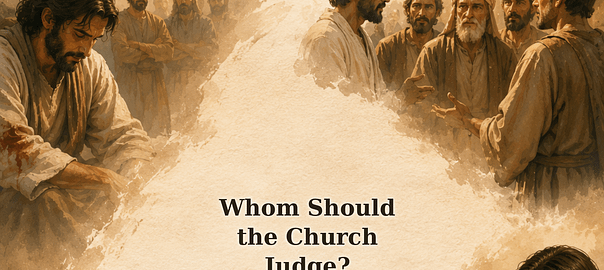
Whom Should the Church Judge?

Some topics have become almost taboo within the church over the years. One of these is judgment. The moment someone quotes “Do not judge, or you too will be judged,” it seems the conversation ends there. As if Jesus had forbidden any form of discernment, correction, or discipline.

The problem is that the church has absorbed much more from the surrounding culture than it realizes. We’ve begun to call love what Scripture never did. A love that never confronts, never corrects, never calls to repentance. A love that only embraces. But this is not biblical love. God’s love is never irresponsible. It is patient, merciful, and full of grace. But precisely because He loves, He also corrects.

Therefore, the question is not whether the church can judge. The question is: whom should the church judge?

Paul answers in a surprising way. “What business is it of mine to judge those outside the church?” And before anyone jumps to conclusions, he explains himself. When he wrote not to associate with sexually immoral, greedy, idolaters, slanderers, drunkards, or swindlers, he wasn’t talking about those who belong to the world. Because if that were the case, he says, “you would have to leave this world.”

This observation completely changes the discussion.

The problem was never living among sinners. If that were the problem, Jesus would never have sat at the table with tax collectors and prostitutes. The church was not sent to flee the world but to proclaim Christ to the world.

So whom is Paul talking about?

The one who calls himself a brother.

The one who wishes to be recognized as a member of the body of Christ, participates in the church’s fellowship, but has decided to remain in rebellion against Christ without any repentance.

The difference is not in the gravity of the sin. It is in the truth of the fellowship.

Because the lost usually know they are lost.

The self-deceived believe they have found Christ while continuing to walk in the opposite direction.

It is precisely this self-deception that the church cannot confirm.

But to understand this, we need to go back a bit.

In Matthew 18, Jesus presents the path of discipline. If your brother sins against you, go and tell him his fault. Alone. If he listens, you have won your brother. If he does not listen, take witnesses. If he still refuses to listen, tell it to the church. Only after this entire process does Jesus say to treat him as a pagan or a tax collector.

Notice that from the beginning, the goal was never to expel someone.

The goal was always to win the brother.

Discipline is the last resort when all attempts at restoration have failed.

At first glance, it seems like a personal problem. One brother sinned against another brother. But only at first glance.

Because the New Testament reveals that no sin within the church is merely a problem between two people.

When Saul persecuted Christians, Jesus did not ask, “Why do you persecute my church?”

He asked, “Saul, Saul, why do you persecute me?”

The attack against the body was treated as an attack against the head itself.

Later, Paul himself would develop this truth. The church is the body of Christ. If one member suffers, all suffer. If one member is sick, the whole body is sick. “Who is weak, and I do not feel weak?” And to the Corinthians, he writes as one who feels “the pains of childbirth” for those brothers.

So discipline ceases to be a conflict between two people.

It becomes a matter of the body of Christ itself.

When one member is sick, the rest of the body cannot pretend nothing happened. Nor can it amputate it for convenience. The body mobilizes everything it has to restore it.

This is exactly what happens in 1 Corinthians 5.

The church was proud of a tolerance that Paul considers incompatible with the gospel. A man was living publicly in sin, refusing to repent, and the church continued to treat it as if it were merely an expression of grace.

Paul reacts.

Not because that man was beyond grace.

But because the church was using grace to confirm a lie.

So he orders that the man be removed from fellowship.

This may be one of the harshest texts in the New Testament.

But only until we read the reason.

The goal is not to destroy him.

It is not to preserve the church’s image.

It is not to demonstrate moral superiority.

It is so that he may awaken.

It is so that he may stop living in the worst possible spiritual state: believing himself united to Christ while deliberately rejecting the lordship of Christ.

Discipline does not break fellowship.

It merely makes visible a rupture that has already occurred in the heart.

But the story doesn’t end there.

Years later, writing again to the Corinthians, Paul instructs them to do the opposite. Now is the time to comfort. It is time to reaffirm love. It is time to receive that brother again, so that he may not be overwhelmed by excessive sorrow.

Whether it was the same person or another case, the principle remains the same.

The same apostle who commanded separation now commands restoration.

Because the goal was never to lose someone.

It was always to recover them.

That is why Hebrews states that God disciplines those He loves.

He does not correct because He stopped loving.

He corrects precisely because He loves.

Perhaps the greatest mistake of the contemporary church is separating these two things.

There are churches that speak so much of grace that they have abandoned discipline.

There are churches that speak so much of discipline that they have forgotten grace.

The gospel allows for neither of these extremes.

The church does not discipline because it considers itself better.

It disciplines because it understands that a sick member compromises the whole body.

And it restores because it understands that the same member remains the target of Christ’s love.

In the end, the mark of a Christian has never been perfection.

Nor is it biblical knowledge, spiritual gifts, or reputation.

The mark of a Christian is repentance.

As long as there is repentance, there is fellowship.

When it disappears, the church loves enough to correct.

And when it reappears, it loves enough to restore.

This is how Christ treats His body. And this is how the body of Christ must learn to care for itself.

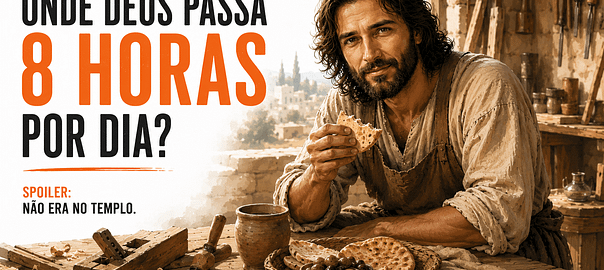
Where Does God Spend Eight Hours a Day?

Where Does God Spend Eight Hours a Day?

Perhaps you’ve never stopped to consider, but where does God spend eight hours a day?

Of course, we know that God exists beyond time and space. Both are His creations, and thus, He is not bound by them. However, whenever God needs to interact with humanity, He does so within the time and space for which man was created.

With this in mind, the question takes on a more tangible form. After all, if angelic beings manifest within this realm (as in the book of Psalms 34:7 – “The angel of the Lord encamps around those who fear him, and he delivers them”) or when God descends on the mountain amidst fire (Exodus 19:18) or when God fills the temple with His presence in a real historical, geographical, and political setting (Isaiah 6), to cite a few examples.

So, the question remains, where does God spend eight hours a day? Some might answer “in the church” (assuming the church is a physical place, for example). Others might say “in the church” (assuming the church is a mystical entity beyond the everyday). Others might say “everywhere.” Some, bordering on pantheism or fully manifesting it, might say “in all things.”

But the question remains valid. If we look at the life of Jesus, the answer is surprising.

Jesus Worked More Than He Preached

There is a stark difference in the time Jesus spent working (something like 20-plus years) and the time He spent preaching (around three years). Roughly speaking, He dedicated 90% of His life to learning and professional life, while a little over 9% was invested in ministry.

He accompanied His stepfather, learning the trade, how to deal with people, how to analyze materials, and how to work those materials to satisfy customers. He must have experienced good and bad times. Deadlines, quality, effort, fatigue.

Why did God choose to manifest His Son in this way?

The Division We Invented

Without realizing it, we’ve learned to divide life into two territories: the sacred and the secular.

The “church” (which for many means the physical building and not the people as in the Bible) has become a sacred place. It would be the site of contact between the earthly and the divine. A piece of holy ground where one walks differently, speaks differently, thinks differently than “in the world.” And this is emphasized on Sunday nights during a 90-minute ritual repeated to exhaustion.

It’s true that in the old covenant (or the Old Testament if you prefer), there was a well-established rigid separation. Instead of the orgiastic relations practiced by other peoples, the proposal God gave the Hebrew people when He chose them included a separation of the holy and the sacred, clearly seen in the burning bush, the veil of Moses, the institution of the priesthood, the tent of meeting during the desert, Solomon’s temple with all its glory, and the second temple with all the earthly splendor Herod the Great gave it.

In the new covenant, at the exact consummation of the perfect priestly sacrifice, the temple veil was torn. Matthew 27:51 describes it splendidly, with details hard to accept or believe but completely compatible with what was happening: a new kingdom (occupying the same time and space as the previous kingdom – Romans 5:21) had just been inaugurated, and – contrary to popular thought – the redemption of the entire creation had begun (not just the souls of some humans).

So, as I was saying, this new covenant, or testament, or era, is gradually perceived by the first disciples and gains momentum and spreads. This necessarily leads to re-reading and reinterpreting many things, but what becomes clear is that what was planned, promised, and awaited in the Old Testament is now crystallized in the new. And what do we see in the letters of the apostles and the author of the book to the Hebrews and the disciples of the apostles? All of them, in their letters, deal with everyday life because it is there that faith becomes concrete.

Work Reveals Who We Really Are

Perhaps God spends so many hours with us at work because it’s there that masks last the least.

Imagine yourself for a moment in those 90 minutes of repetitive communal worship. There are no surprises, hence no renewal of thought. There’s also little room for impatience, lying, or pride. If I only know you from Sunday night, we both might carry the impression that we are almost saints (not in the sense of chosen ones, but as people of impeccable conduct and thought).

Now, let me accompany you to work for a few days. Without you knowing that I am an evangelical pastor or your brother in faith. Just a new colleague at work. Or vice versa, you accompany me to my work. You, who started working in the same environment as I did last Monday.

It’s there where we will know and be known for patience, pride, ambition, lying, justice, generosity, forgiveness. The office, the workshop, the classroom, or the factory function as laboratories for true sanctification.

There is no longer a distinction between a sacred place and a secular one. What exists is the Kingdom of God (or the Kingdom of Heaven, depending on which evangelist you prefer) advancing and the gates of Hades being stormed by the movement of God’s children.

Work Was Never a Curse

Sin made work burdensome, not that work is an invention of Sin. (Note for readers, the distinction of usus loquendi between “sin” – lowercase – and “Sin” is to distinguish the former as personal decisions against God’s will, while the latter is the kingdom of sin inaugurated with man’s fall – Romans 5:12..)

Work was never a punishment; it was the original plan. From the beginning, God placed man in the garden to “work it and take care of it” (Genesis 2:15) and gave him purpose to rule and fill the earth (Genesis 1:28). Both creation accounts contain this same idea.

What became a curse was the frustration and pain that entered with the fall: “through painful toil you will eat food from it… by the sweat of your brow” (Genesis 3:17-19), and even the pains of childbirth point to this reality of tribulation (Genesis 3:16). That’s why creation groans “as in the pains of childbirth” (Romans 8:19-22) while God Himself does not give up on it: its restoration continues until the consummation of the “new earth,” when everything is made new (Revelation 21:1-5). Thus, the kingdom here and now is a continuation of the original plan, and also in the final manifestation, there will be service in the renewed world – not punishment (Revelation 21:3-4; 22:3-5).

Before the fall, then, there was already cultivation, care, creativity, organization, responsibility. The cultural mandate comes before sin. Fatigue is a consequence of the fall; work is not.

And simplifying the last big paragraph (but without which I would be leaving you in the dark about the biblical view): Working is part of the image of God. We create because we were created by a Creator.

God Continues to Work

Jesus said, “My Father is always at his work to this very day, and I too am working” (John 5:17). This statement is no joke.

We understand that the Bible is the only rule of faith and practice. And we also understand that it is a progressive self-revelation of God in the guise of human experience. Therefore, if Jesus (the ultimate manifestation of the Word of God) is saying that things are a certain way, we can rest assured that it is exactly that way and no other, no matter how similar it may seem.

God did not rest from creation because He lost interest in it. He continues to sustain, govern, reconcile, and guide history. Worthy work is a reflection of this God who remains active.

A Final Look at Eternity

In previous paragraphs, I nudged you a bit with the idea that eternity is a time/space of service. I left it simmering because perhaps it was already too much with the notion that work is not a divine punishment. Come with me now to take a look from the other end of history.

Perhaps our imagination about heaven (as God’s dwelling place and from where the celestial Jerusalem descends) is too small.

It’s not hard to find limiting caricatures of clouds, little angels with wings, harps, smiles like a gelatin or margarine commercial… well.

The Bible concludes its narrative with a city, not an empty garden. There is culture, kings bringing their glory, service, creativity, governance, and fullness. We will not work to survive, but because creation will finally be what it was always meant to be. Work ceases to be survival and returns to being joy.

Finally

Perhaps the question was never how to serve God at work.

Many times, pseudo-glorious stories are heard of people who steal from their employers by using work hours for proselytizing evangelistic actions.

Others have understood that “Bringing Christ to the office” means carrying a crucifix or reading the Bible in public. And other similar things.

It’s quite likely that it’s not about how to serve God at work, but discovering that He is already working there long before we arrive, and it’s quite likely that the only Bible people will ever read in their lives is just those eight hours they spend with us at work.

What would a company look like where Jesus worked eight hours a day?


And, even more uncomfortably: Could it be that He already works at yours?